
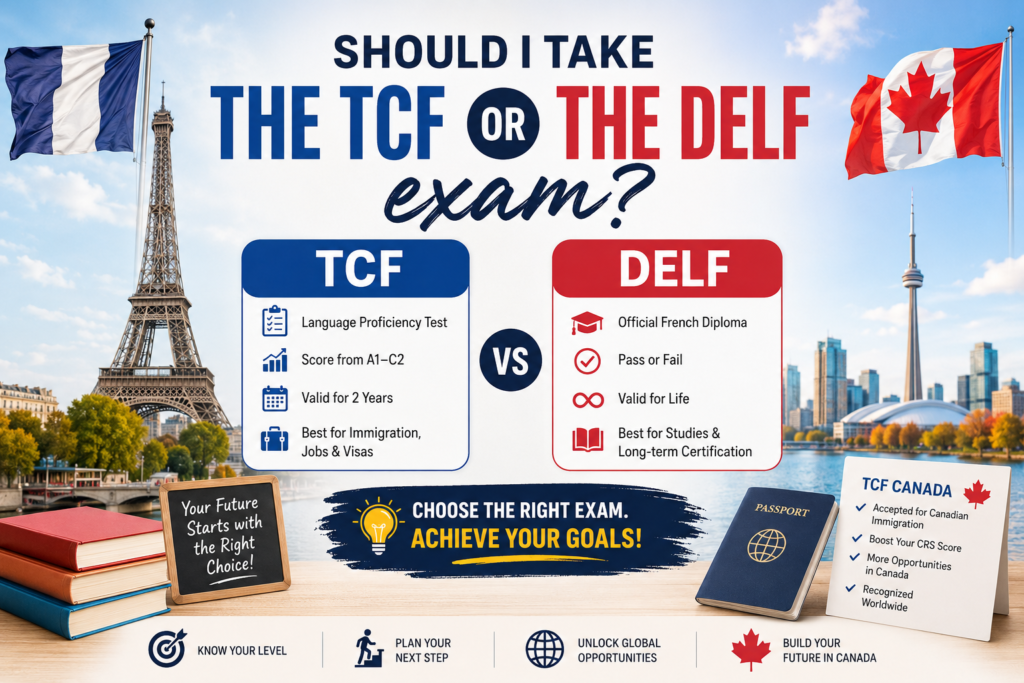
If you’re planning to study abroad, work in a French-speaking country, or immigrate to Canada, one of the first questions you’ll encounter is: Should I take the TCF or the DELF exam?
Although both exams evaluate your French language proficiency according to the Common European Framework of Reference for Languages (CEFR), they serve very different purposes. Choosing the wrong exam could cost you valuable time, money, and even affect your immigration or admission plans.
This comprehensive guide explains the differences between the TCF, TCF Canada, and DELF exams, helping you determine which certification best matches your goals.
What is the TCF?
The Test de Connaissance du Français (TCF) is an official French language proficiency test developed by France Éducation International (FEI) on behalf of the French Ministry of Education.
Unlike DELF, the TCF does not certify a fixed level. Instead, it measures your current French ability and assigns a score corresponding to CEFR levels A1 to C2.
Your TCF certificate remains valid for two years, making it ideal for organizations that require proof of your current language proficiency.
There are several versions of the exam, including:
- TCF Tout Public
- TCF Québec
- TCF Canada
- TCF IRN (Integration, Residence and Nationality)
What is DELF?
The Diplôme d’Études en Langue Française (DELF) is an internationally recognized diploma issued by the French Ministry of Education.
Unlike TCF, DELF is a pass-or-fail examination. You register for a specific level (A1, A2, B1 or B2), and if you pass, you receive a diploma that is valid for life.
If you fail, you do not receive certification for another level.
Because DELF is a diploma rather than a proficiency test, many universities and employers recognize it as permanent proof of French language skills.
TCF vs DELF: Quick Comparison
| Feature | TCF | DELF |
|---|---|---|
| Type | Language proficiency test | Official diploma |
| Validity | 2 years | Lifetime |
| Result | Score from A1–C2 | Pass or Fail |
| Choose your level? | No | Yes |
| Best for | Immigration, admissions, employment | Academic studies, long-term certification |
| Difficulty | Depends on current level | Depends on level chosen |
When Should You Choose the TCF?
The TCF is the better option if you:
- Want to immigrate to Canada
- Need recent proof of French proficiency
- Are applying for a visa
- Need French certification quickly
- Want to know your exact CEFR level
- Plan to apply for jobs requiring current language assessment
Since the exam measures your existing ability, you don’t need to choose a level before registering.
When Should You Choose DELF?
DELF is ideal if you:
- Want a lifetime French diploma
- Are applying to French universities
- Need permanent language certification
- Want international recognition for academic purposes
- Prefer preparing for a specific CEFR level
Many students choose DELF because they can progressively complete A1, A2, B1 and B2 over time.
TCF Canada: The Best Choice for Canadian Immigration
One of the biggest trends among French learners today is preparing for TCF Canada.
With Canada continuing to encourage French-speaking immigrants through various immigration pathways, thousands of candidates are choosing TCF Canada to maximize their Comprehensive Ranking System (CRS) score under Express Entry and other eligible programs. TCF Canada is one of the French tests accepted by Canadian immigration authorities for these purposes.
What is TCF Canada?
TCF Canada is a specialized version of the TCF designed specifically for Canadian immigration.
It evaluates four mandatory language skills:
- Listening
- Reading
- Writing
- Speaking
Your scores are converted into the Canadian Language Benchmarks (CLB/NCLC), which are used to calculate immigration points.
Benefits of TCF Canada Certification
1. Accepted for Canadian Immigration
TCF Canada is officially accepted for major Canadian immigration programs that recognize approved French language tests, including Express Entry and several Provincial Nominee Programs (PNPs).
2. Increase Your CRS Score
Strong French scores can significantly improve your CRS score, making you more competitive for permanent residency invitations.
3. More Immigration Opportunities
Canada continues to promote Francophone immigration outside Québec, creating additional opportunities for qualified French-speaking candidates through targeted immigration initiatives.
4. International Recognition
TCF is respected by educational institutions, employers and government organizations worldwide.
5. Faster Career Opportunities
Many Canadian employers value bilingual professionals, especially those fluent in English and French.
6. Accurate Assessment
Unlike DELF, TCF provides an accurate snapshot of your current proficiency rather than simply indicating whether you passed or failed a selected level.
Can DELF Be Used for Canadian Immigration?
This is one of the most common misconceptions.
For Canadian permanent residence through Express Entry, applicants generally need an approved immigration language test such as TCF Canada or TEF Canada. A DELF diploma alone is not accepted for Express Entry language scoring because immigration authorities require a recent standardized test with scores that can be converted to Canadian Language Benchmarks (CLB/NCLC).
However, DELF may still be accepted in certain non-immigration contexts, such as university admissions or, in some circumstances, as proof of French for Canadian citizenship if it meets the government’s accepted requirements. Always verify the latest official eligibility rules before applying.
Which Exam is Easier?
There is no universally “easier” exam.
It depends on your goals and learning style.
Choose TCF if:
- You prefer multiple-choice comprehension sections.
- You need a current language assessment.
- You’re applying for Canadian immigration.
- You want to know your exact proficiency level.
Choose DELF if:
- You want a permanent diploma.
- You’re comfortable preparing for one fixed level.
- Your goal is university admission or long-term certification.
Many learners find TCF more flexible because it evaluates your existing skills without requiring you to commit to a specific level beforehand, while DELF rewards thorough preparation for one targeted level.
Current Trends Among French Learners
Recent demand shows several clear trends:
- Growing interest in TCF Canada due to increased Canadian immigration opportunities for French speakers.
- Higher demand for online TCF preparation classes.
- Greater emphasis on achieving CLB/NCLC 7 or higher to improve immigration competitiveness.
- Increased use of AI-powered mock tests, adaptive practice platforms and speaking simulations to prepare efficiently.
Final Verdict: TCF or DELF?
The right exam depends entirely on your objective.
Choose TCF or TCF Canada if you:
- Want Canadian PR
- Need recent language certification
- Require French for immigration
- Want to know your current proficiency level
Choose DELF if you:
- Need a lifetime diploma
- Are applying to French universities
- Want permanent proof of your French level
- Prefer progressing through fixed CEFR levels
For most candidates aiming to build a future in Canada, TCF Canada remains the more strategic option because it aligns directly with Canadian immigration requirements and can strengthen your immigration profile.