
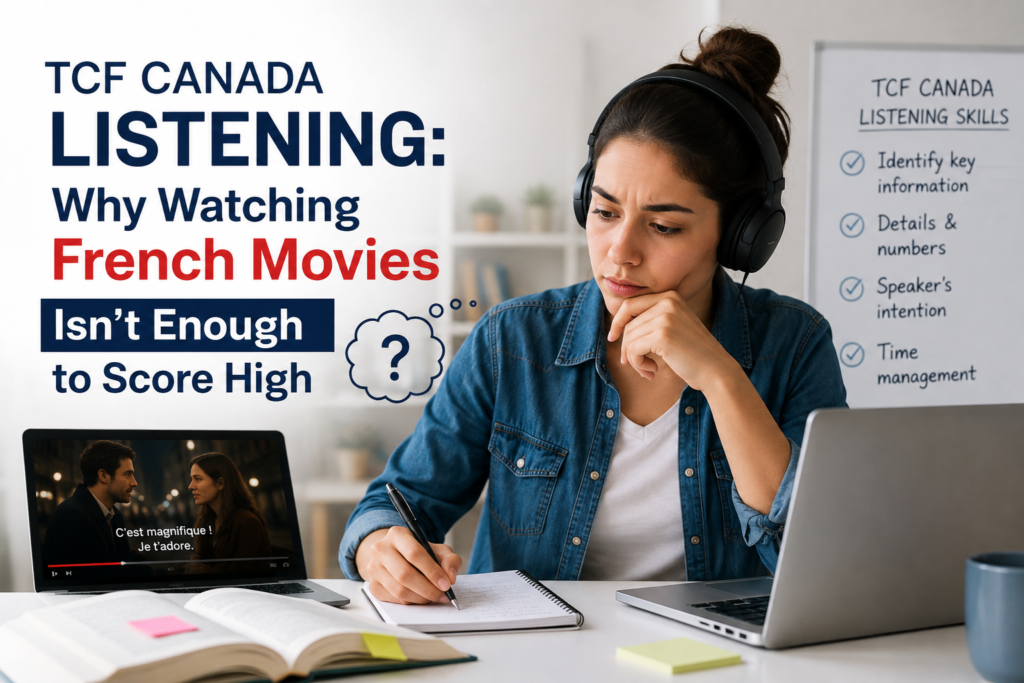
If you can understand French movies, TV shows, YouTube videos, or podcasts, you may assume that the TCF Canada listening test will be easy. After all, listening to native French speakers should improve your comprehension skills—right?
While French movies can certainly help you become more familiar with the language, understanding French entertainment content is not the same as scoring well in the TCF Canada listening section. The exam tests specific listening abilities under time pressure, and candidates need to understand how to identify key information quickly and accurately.
Why French Movies Help—but Are Not Enough for TCF Canada Listening
Watching French films can improve your exposure to natural pronunciation, vocabulary, accents, and conversational expressions. It can also train your ear to recognize French as it is spoken in real-life situations.
However, when watching a movie, you usually have several advantages. You can understand the story through visuals, facial expressions, background situations, music, and context. Even if you miss a few sentences, you can still follow what is happening.
The TCF Canada listening exam is different. You must listen carefully and select the correct answer based on the information provided. Missing one important word, number, opinion, or detail can change your answer completely.
In other words, the goal is not simply to understand the general meaning. You need to identify the exact information required by the question.
The TCF Canada Listening Test Requires Active Listening
One of the biggest challenges in TCF Canada listening preparation is learning how to listen actively.
When watching a French movie, you can relax and focus on the overall story. During the TCF Canada exam, however, you need to quickly identify important details such as:
- Dates and times
- Prices and quantities
- Locations
- Reasons and opinions
- Relationships between speakers
- The speaker’s intention
- Specific instructions or changes
Candidates often understand 80% or even 90% of an audio recording but still choose the wrong answer because they miss one critical detail.
This is why regular exposure to French movies should be combined with targeted TCF Canada listening practice.
Movies Do Not Always Prepare You for Exam-Style Questions
Another important difference is the structure of the content. Movies are designed to entertain, while the TCF Canada exam is designed to evaluate your French comprehension skills.
In the exam, you may encounter short conversations, announcements, telephone messages, interviews, discussions, or everyday situations. You must process the information quickly and connect what you hear with the available answer choices.
A candidate who understands a French film may still struggle with multiple-choice questions because the difficulty is not always the vocabulary. Sometimes, the challenge is identifying the difference between similar options.
For example, the recording may mention several places, but only one is connected to the final decision. If you focus on the first familiar word you hear, you may select the wrong answer.
Why Vocabulary Alone Will Not Guarantee a High Score
Many students preparing for TCF Canada spend most of their time memorizing French vocabulary. While vocabulary is essential, listening comprehension also requires fast processing.
You need to recognize words immediately without mentally translating every sentence into English or another language.
If you are translating word by word in your mind, you may fall behind while the audio continues. This can cause you to miss the next important piece of information.
Effective TCF Canada listening preparation should therefore focus on understanding French directly, recognizing common expressions, predicting possible answers, and identifying keywords.
Karan Kataria TCF Canada Exam Preparation
For candidates looking for structured guidance, Karan Kataria TCF Canada exam preparation can help students develop a focused approach to the listening section. Instead of relying only on general French exposure, preparation can include exam-oriented listening practice, vocabulary development, question analysis, mock tests, and strategies for identifying important information under time pressure. A personalized approach can also help candidates understand their weaknesses and work specifically on the skills needed to improve their TCF Canada score.
How to Improve Your TCF Canada Listening Skills
The best strategy is to combine different types of French listening practice. Continue watching French movies and videos because they help you become comfortable with natural French. However, also practise with exam-style audio exercises.
Focus on understanding:
- What is the main topic?
- Who is speaking?
- Why are they speaking?
- What specific information is important?
- Is the speaker changing their opinion or decision?
Regular TCF Canada mock tests can also help you understand how quickly you need to process information.
Final Thoughts
Understanding French movies is a valuable skill, but it does not automatically guarantee success in the TCF Canada listening test. Movies train you to understand stories and natural conversations, while the exam requires precision, speed, concentration, and the ability to identify specific details.
The most effective TCF Canada preparation combines general French exposure with targeted exam practice. By training yourself to listen actively and recognize important information quickly, you can move beyond simply understanding French—and start preparing strategically for the score you need.